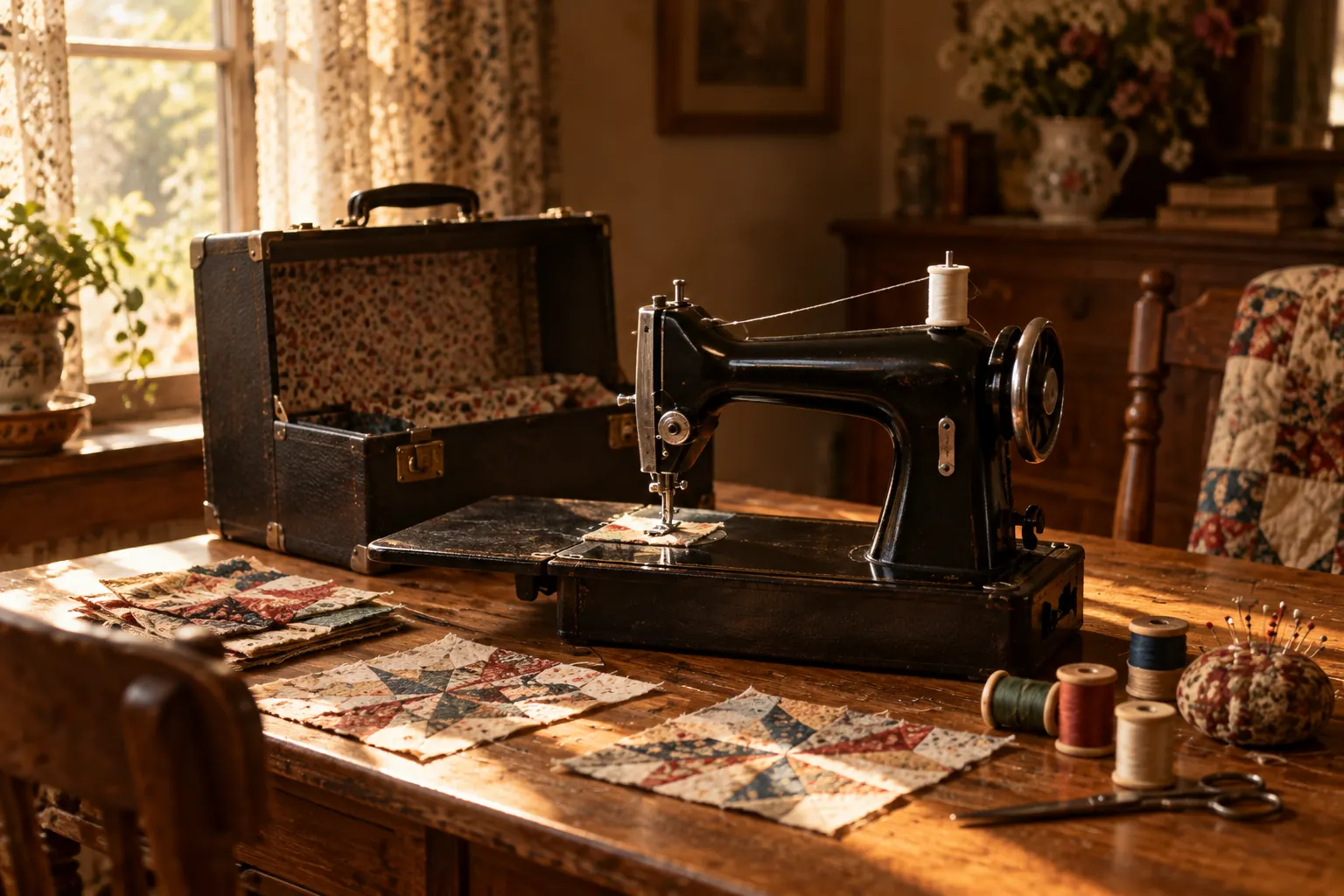
The Featherweight began outside Singer. Wikipedia credits Raymond Plumley and Richard Hohmann, engineers at the Frederick Osann Company, with a lightweight cast-aluminium machine designed in 1928. Singer developed the idea into the Model 221, and singer-featherweight.com records the first batch of 10,000 being commissioned at Elizabethport on 3 October 1933.
Its public debut was at the Chicago World’s Fair. Sources differ on the year: sewalot says 1933, while Wikipedia and singer-featherweight.com say 1934, and some machines carry a “Century of Progress Chicago 1934” badge. At roughly a third of the weight of other machines (sewalot), it was a full-function lockstitch machine you could carry by one hand.
Production stopped from 1942 to 1944 under the War Production Board’s Limitation Order L-98, then resumed in September 1945. Kilbowie in Scotland joined in August 1947. Black machines ended in 1961, and the white 221K and tan 221J carried the line to the late 1960s. Today it is prized by quilters for its straight stitch and portability.
The familyThe four Featherweights
“Featherweight” covers four machines. They share the same bobbin (Class 221, part 45785) and bobbin case (45751), and the same standard attachments.
221 · 1933–1961 (black)
Black 221
The classic: black cast aluminium, gold decals, a fold-up bed extension. US machines have a chrome-rimmed handwheel; Scottish ones a plain black wheel.
Made at: Elizabethport, New Jersey; Kilbowie, Scotland as the 221K from August 1947
Singer 221 guide221K · 1955–64 or 1961–69 (sources vary)
White 221K
White or pale turquoise (“celery”), with no decorative decals and a controller wired straight in. The last version, the 221K7, is belt-driven and slightly quieter.
Made at: Kilbowie, Scotland
221 versions221J · 1961–69
Tan 221J
A tan machine made mostly in Canada at the end of the line.
Made at: St Jean, Quebec, Canada (singersewinginfo also says Scotland)
221 versions222K · July 1953–1961
Free-arm 222K
Looks like a black 221, but part of the bed lifts off to leave a free arm and a SEW/DARN lever drops the feed dogs. Serials run EJ to ES; about 100,000 made. Not sold in the USA.
Made at: Kilbowie, Scotland only
Singer 222K guideIdentifyWhich Featherweight do I have?
What colour is it?
White or pale turquoise means a 221K; tan means a 221J. Black could be a 221 or a 222K.
Does part of the bed lift off?
If a section of the bed comes away to leave a narrow arm, and there is a lever marked SEW and DARN, it’s a 222K.
Read the serial prefix
US 221s carry A-series prefixes (AD–AM, for example). Scottish machines carry E-series prefixes; every 222K starts EJ to ES.
Check the handwheel and plug
A chrome-rimmed handwheel and round-pin plugs mean a US machine; a black painted wheel and flat pins mean a UK one.
Then look up the serial number for the year and factory.
DatingFeatherweight timeline: faceplates, decals and badges
Use the serial number to date the machine; use this timeline to check that its faceplate, decals and badge belong to that date. More on the patterns in our Singer decal guide.
| Year | What changed |
|---|---|
| 1933 | First batch. The first 10,000 221s are commissioned at Elizabethport on 3 October 1933. Early machines carry Celtic decals (ISMACS: Celtic Chain, 1933–53). |
| 1937 | Scrolled faceplate. US machines get the scrolled faceplate, used until 1947 (to about 1951 in the UK). |
| 1939–40 | Wrinkle finish. A rare crinkle-finish run, nicknamed “Godzilla”, with grooves in the bed instead of decals. singer-featherweight.com knows of 43. |
| 1941 | Blackside. From July 1941 wartime machines have blackened parts in place of chrome. |
| 1942–45 | Wartime pause. No Featherweights are made under Limitation Order L-98. Production resumes in September 1945. |
| 1947 | Scotland joins. Kilbowie starts making the 221K in August. The striated (lined) faceplate arrives. |
| 1952–53 | Graduated plate and Prism decals. A throat plate with seam-guide lines from 1952; ISMACS records Prism decals from 1952–53 (sold today as “gold paperclip”). A small “221-” emblem appears in mid-1953. |
| 1953 | 222K launched. Kilbowie begins the free-arm 222K in July. |
| 1959–61 | Red S badge. The red “S” badge appears on black 221s and 222Ks from mid-1959. |
| 1961–69 | White and tan. Black machines end in 1961. The white 221K and the tan 221J carry the line to the late 1960s. |
FurnitureCases and tables
Case styles changed several times, from the D-ring handle of late 1934 to the 1953 case with an integrated handle and controller bracket. The 222K came in a two-tone blue case. For home use Singer made the No. 68 maple cabinet (design patent 1947) and folding card tables, Nos. 308–316, whose table and insert carry matching serial numbers. See Singer tables and cabinets.
Before you buyWhat to check on a used Featherweight
In-person checks
MaintenanceLooking after a Featherweight
Clean lint out, then put one drop of sewing machine oil in each oil hole: about one drop a month if you sew daily, one a year for occasional use. Sewalot warns that over-oiling can impair sewing.
Black, tan and early white motors have two lubricant ports with felt wicks. Fill them with proper motor lubricant once or twice a year. Never put sewing machine oil or petroleum jelly in the motor (singer-featherweight.com).
Black and tan Featherweights have gears to grease at the top and bottom of the machine. The belt-driven white 221K should not be greased at these points (singer-featherweight.com).
Full care notes are on the 221 page. If in doubt, follow the Singer manual.
QuestionsFrequently asked questions
What is a Singer Featherweight?
A small, portable, straight-stitch Singer with a cast-aluminium body, weighing just over 11 lb. The main model is the 221 (1933 to the 1960s); the 222K is its free-arm sister.
How many Featherweights were made?
About 3 to 3.5 million 221s, according to Wikipedia and sewalot, and about 100,000 222Ks (110,000 by sewalot’s count).
What is the difference between the 221 and the 222K?
The 222K has a removable bed section that turns it into a free-arm machine, and a lever that drops the feed dogs for darning. It was made only in Scotland, from 1953 to 1961, and is slightly taller, so it may not fit a 221 case.
How do I date my Featherweight?
Use the serial number on the bed in our lookup. The faceplate, decals and badge then show whether parts are original to that date.
Is my Featherweight valuable?
Featherweights are among the most sought-after vintage Singers, and the 222K is rarer still. Condition, completeness (case, controller, attachments) and a good stitch matter most. Check real sold prices with our sold-price finder.
Was there a Featherweight table?
Yes. Singer made the No. 68 maple cabinet and folding card tables (Nos. 308–316) for it. See our tables and cabinets guide.
ReferencesSources
Where sources disagree we show both. Spotted an error? Tell us.
- singer-featherweight.com/blogs/schoolhouse/singer-featherweight-faqs
- singer-featherweight.com/blogs/schoolhouse/timeline-history-of-the-singer-featherweight
- ismacs.net/singer_sewing_machine_company/singer_featherweight_sewing_machine.html
- sewalot.com/singer_featherweight_222_221_alex_askaroff_sewalot.htm
- en.wikipedia.org/wiki/Singer_Featherweight
- singer-featherweight.com/blogs/schoolhouse/motor-lubricant
- singer-featherweight.com/blogs/schoolhouse/learning-about-motor-felt-wicks
- singer-featherweight.com/blogs/schoolhouse/free-arm-featherweight-222k-and-how-it-differs
- www.singersewinginfo.co.uk/singer_machines/featherweight
- www.singersewinginfo.co.uk/singer_machines/featherweight/models/221k
- www.singersewinginfo.co.uk/singer_machines/featherweight/models/221k7
- www.singersewinginfo.co.uk/singer_machines/featherweight/featherweight_accessories
- www.singersewinginfo.co.uk/singer_machines/featherweight/buying_tips
- www.goldstartool.com/featherweight-bobbin-case-singer-45751.htm
- www.singer301.com/accessories/default.html
- www.singersewinginfo.co.uk/singer_machines/featherweight/models/222k
- singer-featherweight.com/products/singer-featherweight-222k-ej6215-fully-restored-in-brandywine
- www.singersewinginfo.co.uk/singer_machines/featherweight/serial_numbers/222k
- ismacs.net/singer_sewing_machine_company/decals/domestics/celtic-chain-221-221k.html
- ismacs.net/singer_sewing_machine_company/decals/domestics/prism-201-221-222.html
- singer-featherweight.com/blogs/schoolhouse/singer-wrinkle-crinkle-featherweight-221
- singer-featherweight.com/blogs/schoolhouse/red-s
- ismacs.net/singer_sewing_machine_company/featherweight_fever_those_elusive_featherweight_cabinets_and_tables.html
Last reviewed October 2026