Step oneDate the medallion
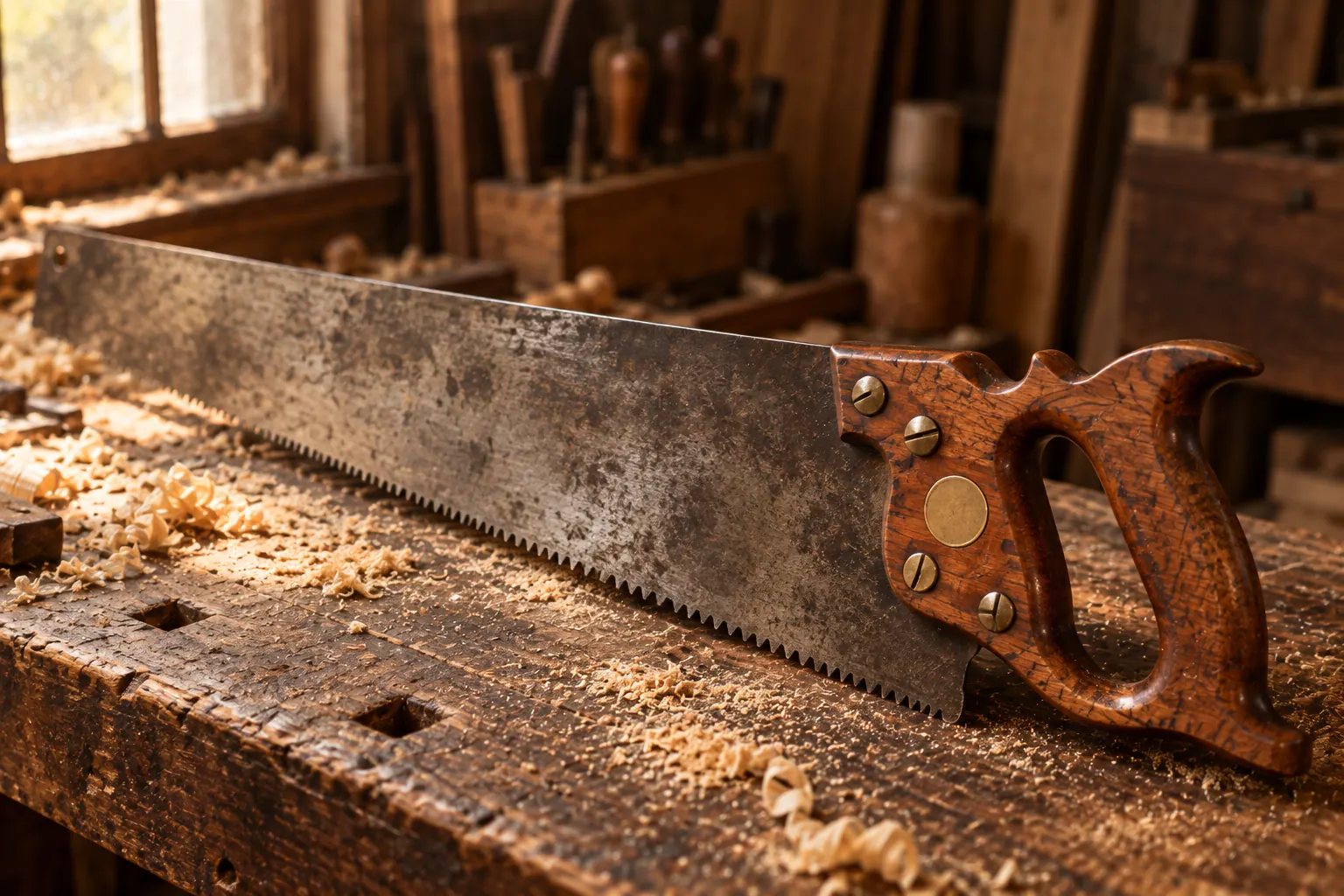
The round brass medallion on the handle is the best dating clue on a Disston saw, according to the Disstonian Institute, whose medallion study this table follows. Parts changed gradually, so mixed features are normal: a saw can have an older etch with a newer medallion.
| Years | Medallion | How to recognise it |
|---|---|---|
| Mid-1840s–1850s | Eagle medallions | An eagle in flight (the earliest), a larger version reading “Keystone Works”, and several other eagles reading “H. Disston. Philada” or “Phila”. Some may have been made at the same time. |
| c.1858–65 | Eagle with stars | A stylised eagle with a star on each side; the older Disstonian Institute page mentions dots at the ends of “Disston” and “Philada”. 1850s and 1860s eagles can’t be reliably told apart. |
| 1865–71 | “One son” | The firm was Henry Disston & Son. Fixed with split nuts. |
| 1871–c.1876 | First keystone with “SONS” | Early ones have a dot after SONS; the rim is sanded flush with the handle. Still split nuts. |
| c.1874–75 | “Choice” | A serrated rim raised above the handle, the first raised medallion. Five split nuts. |
| 1876–77 | Domed nuts | Fixed with domed cap-screw nuts (patented 29 August 1876); rim raised above the wood. |
| 1878–88 | Stars beside the keystone | A star on each side of the keystone, often a comma after “sons”, sometimes “webbing” inside the keystone. |
| 1888–96 | 1887 patent date | Carries the 1887 saw-nut patent date; some have daisy-like six-pointed stars. |
| 1896–1917 | Turn-of-the-century keystone | About 90% of the Disston saws collectors find carry this medallion or a later one. |
| 1917–40 | “DISSTON” over the keystone | The plain word DISSTON arched over the keystone. The older Disstonian Institute page ends it in 1940 or 1942. |
| 1940–47 | Country named | Names the country, not just the city. Some wartime saws have steel medallions. |
| 1947–53 | Wide rim | Sloppy stamping and a wide rim; nickel-plated on the D-8 and D-12, plain on the D-7. |
| 1953–55 | Last family-owned | All medallions 13/16 in.; the last made before the 1955 sale. |
| 1955–c.1990 | H.K. Porter era | Made after the sale to H.K. Porter of Pittsburgh. |
- Cast or stamped? Medallions before 1868 were sand-cast brass, brittle and light; later ones were stamped from sheet brass.
- Size. Full-size saws have about 1 in. medallions; panel saws and backsaws 13/16 in., as do all saws after 1953.
- “Warranted Superior” is a generic eagle used on cheaper saws for over a century, not an early Disston.
Step twoRead the etch
- Disston began etching blades around 1865. Until the early 1880s the lettering has curled serifs.
- Etches read “& Son” from 1865 to 1871 and “& Sons” after, when Albert Disston joined.
- French and Spanish trademark marks were added in the early 1910s.
- After 1928 model names start with D and a hyphen (D-7, D-12, D-23).
- After the 1955 sale to H.K. Porter the etch uses large block letters.
Step threeHandle and saw nuts
- Split nuts until about 1876; domed nuts patented 29 August 1876.
- 1928 redesign: the only line-wide change. Most models got a closed-top handle with a larger hand hole, and the decorative nib on top of the handle was dropped.
- Wood: beech on basic saws, applewood on better ones until about 1945, then other hardwoods lacquered to look like apple.
- Patents: Henry Disston’s skewback blade (US 152,347, 23 June 1874) and the thumbhole handle (12 May 1874), offered on long rip saws from about 1880 to 1950.
ReferenceDisston models
| Model | Years | Grade | How to recognise it |
|---|---|---|---|
| No. 7 / D-7 | No. 7 1840–1928; D-7 1928–55 | Basic | Beech handle, straight back, four nuts (three on panel saws). The lamb’s tongue on the handle is on the No. 7 only. The 1890 catalogue called it the cheapest saw that carried Disston’s own name. |
| No. 8 | c.1845–1918 | Mid | Apple handle, four nuts; much less common than the No. 7. |
| D-8 | From 1874 (as the No. 80 “Choice”); D-8 by 1879, to 1955 | High | Skewback blade, closed apple handle, five nuts (four on panel saws); thumbhole rip version. The 1932 catalogue called it Disston’s best-known and largest-selling saw. |
| No. 12 / D-12 | c.1865–1928; D-12 to the early 1950s | Top | Carved, polished applewood handle (walnut after WWII), straight back, four nuts (five on the D-12). Perhaps the top of the line. |
| No. 16 | 1880–1928 | Premium | Carved apple handle let into the blade, straight back; less common than the No. 12. |
| No. 120 “Acme” | c.1875–1928 | Premium | Skewback, extra-taper blade with unset teeth, carved apple handle, thumbhole on 28 and 30 in. sizes; “designed only for first-class workmen” (1890 catalogue). |
| D-15 / D-115 “Victory” | 1915–1950s | Premium | Carved rosewood handle; plywood in the late 1940s. |
| D-23 | 1911 to about 1990 | Mid | Straight back, lightweight from about 1927. Very common and a good user saw; those made before 1955 are better than anything Disston sold later. |
| D-95 “Masterpiece” | 1935–55 | Top | A Tenite plastic (“Disstonite”) handle; carved rosewood in 1955. The 1940 catalogue called it “the finest saw ever made”. |
BackgroundDisston company timeline
| 1840 | Henry Disston starts his own business in Philadelphia. Sources differ on when the “Keystone Saw Works” name begins: 1840 (Wikipedia, Henry Disston) or about 1850. |
| 1865 | Henry Disston & Son; “& Sons” from 1871. |
| 1872 | Building begins at Tacony; the move takes more than 25 years. |
| 1878 | Henry Disston dies. |
| 1886 | The company is incorporated. |
| 1928 | The line-wide redesign; D-prefixed model names. |
| 1955 | Sold to H.K. Porter of Pittsburgh. Later owners include Sandvik (1972 or 1978; sources vary) and R.A.F. Industries (1984). |
Before you buyHow to check an old saw
Saw checks
ValueWhat is my Disston saw worth?
The Disstonian Institute doesn’t give appraisals and we don’t publish price lists. Most Disstons survive in large numbers and sell as user saws; condition, a readable etch and the model matter most. Check what the same model has sold for:
QuestionsFrequently asked questions
How do I date a Disston saw?
By the medallion on the handle first. The Disstonian Institute treats it as the most reliable clue and the blade etch as less reliable. Then check the etch, the handle shape and the saw nuts.
What does “Warranted Superior” on a saw mean?
It’s a generic eagle medallion used for over 100 years on cheaper saws by Disston and other makers, and on Disston replacement medallions. Don’t mistake it for an early Disston eagle.
Is my Disston saw valuable?
Most are user tools. The Disstonian Institute does not give appraisals; its FAQ suggests a rare pre-1850 saw might fetch about $5,000, and a No. 7 from that period several hundred dollars, depending on condition. Check sold prices for your model.
Is my saw rip or crosscut?
Rip teeth have a straight front and are filed straight across; crosscut teeth lean back and are filed at a bevel. The commonest sizes were 8 points per inch for crosscut and 5½ for rip.
Will cleaning remove the etch?
It can. Use a sanding block and go very slowly over the etch; if rust is deeper than the etch, the etch goes with it (Disstonian Institute).
Did Disston make saws in Canada?
Yes. The Disstonian Institute says Disston had a factory in Toronto from 1910 until at least the 1950s, making the same models.
ReferencesSources
Dates follow the Disstonian Institute, which describes them as estimates. Where sources disagree we show both. Spotted an error? Tell us.
- disstonianinstitute.com/medv2.html
- disstonianinstitute.com/medallionpage.html
- www.disstonianinstitute.com/etch.html
- disstonianinstitute.com/faq.html
- disstonianinstitute.com/quickglance.html
- disstonianinstitute.com/7page.html
- disstonianinstitute.com/d8page.html
- disstonianinstitute.com/12page.html
- disstonianinstitute.com/d23page.html
- disstonianinstitute.com/acmepage.html
- disstonianinstitute.com/d95page.html
- disstonianinstitute.com/patent06231874.html
- disstonianinstitute.com/sawfiling1.html
- en.wikipedia.org/wiki/Henry_Disston
- en.wikipedia.org/wiki/Disston_Saw_Works
- philadelphiaencyclopedia.org/?p=31822
- findingaids.hagley.org/repositories/2/resources/160
- collections.ingenium.ca/item/2017.0369.001
Last reviewed October 2026