Key points
- Low shank: 15, 66 (except 66-1), 99, 201, 221, 222K. Singer’s most common shank.
- Slant shank: 301 (Singer’s first), 401A, 403A, 404, 500A, 503A.
- Back-clamping: early 66s, screwed onto the back of the presser bar.
- Buttonholer cases: green means low shank, pink or maroon means slant shank.
- A low-shank walking foot fits the 15-91, 221 and other low-shank Singers.
Step 1Low shank, slant shank or back clamping?
| Shank | Height (approx.) | Vintage Singers |
|---|---|---|
| Low shank | About ½ in | 15, 66 (later), 99, 201, 221, 222K |
| Slant shank | About 7/8 in, angled | 301, 401A, 403A, 404, 500A, 503A |
| Back clamping | About 7/8 in | Early 66s, such as the 66-1 |
| High shank | About 1 in | Mostly industrial machines |
Heights are from singer-featherweight.com, which stresses that feet are not interchangeable between types. Measure from the bottom of the foot to the centre of the thumbscrew to check.
Step 2Types of sewing machine feet
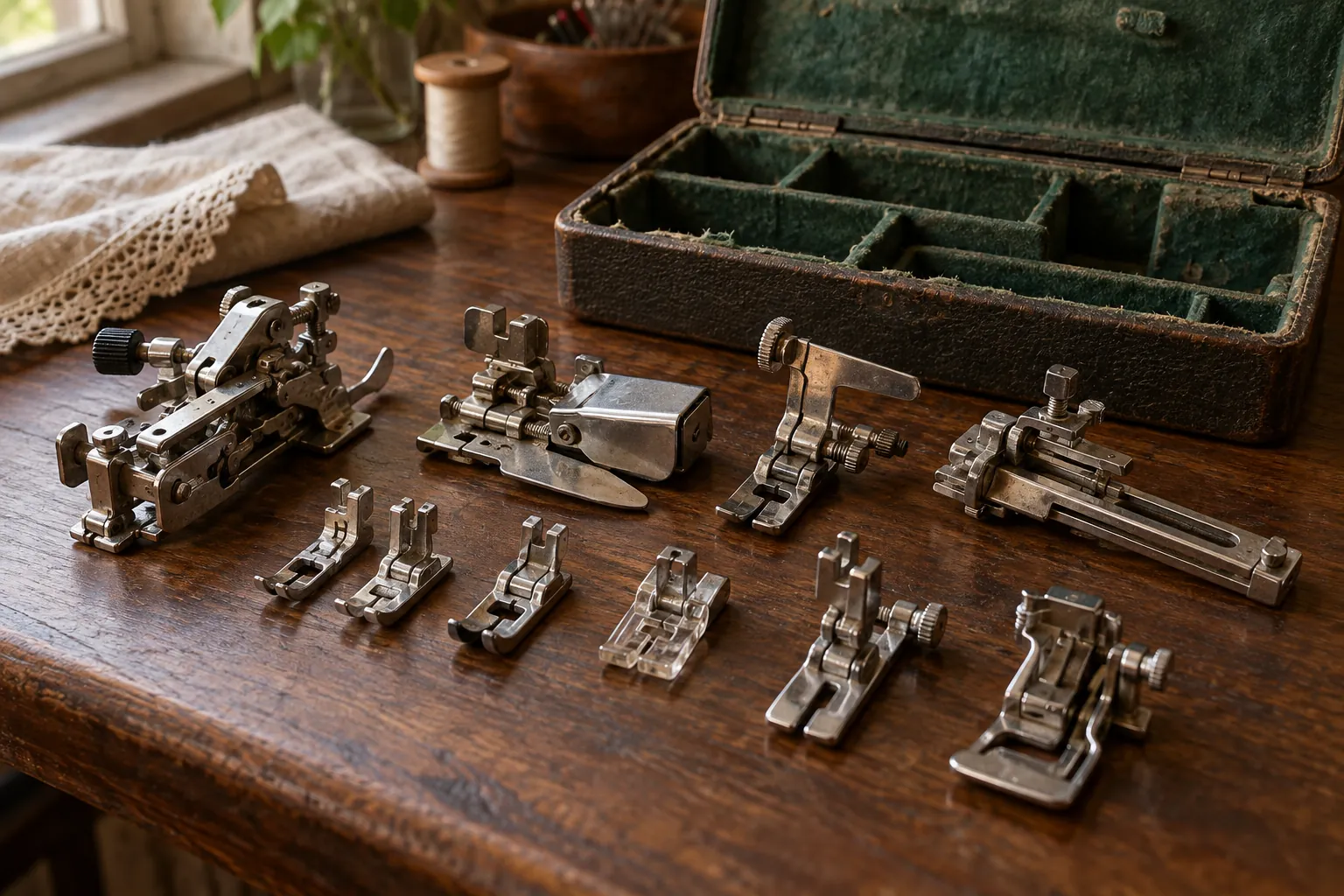
- General-purpose (straight-stitch) foot: the standard foot.
- Zipper/cording foot: sews close to a zip or piping.
- Quarter-inch foot: for accurate patchwork piecing; made for low and slant shank.
- Hemmers: narrow and adjustable hemmers roll a hem as you sew.
- Binder: folds bias binding over an edge.
- Edge stitcher, tucker, gathering foot and ruffler: for edges, pin tucks and gathers.
- Walking (even-feed) foot: feeds the top layer with the bottom one, for quilts, vinyl and soft leather.
Singer sold many of these in a boxed set of attachments. singer-featherweight.com publishes part numbers for the Featherweight’s set: for example the adjustable hemmer 35931, the bias binder 36594 and the ruffler 120598.
Walking footDoes a walking foot fit a vintage Singer?
Yes, on low-shank machines. A modern low-shank walking foot (for example part P60400) is listed for the 15-91, the 221 Featherweight and all low-shank Singers. Slant-needle machines need a slant-shank version. A walking foot attachment is different from a walking-foot industrial machine, which is what leatherworkers mean by the term; see leather and heavy fabric.
ButtonholesVintage Singer buttonholers
Straight-stitch Singers make buttonholes with a buttonholer attachment, which moves the fabric in a pattern rather than moving the needle, and comes with a feed cover plate. The common models:
- 121795: early low-shank buttonholer, 3/8 in to 1 in buttonholes.
- 160506 (low) and 160743 (slant): template buttonholers, green “treasure chest” case for low shank, maroon for slant.
- 489500 / 489510 “Jetson” pair: green clamshell case = low shank, pink case = slant shank.
- 102878 (low) and 381116 (slant): the later “Professional” zigzag buttonholers with twenty templates.
ISMACS and Wikipedia swap the 489500 and 489510 numbers, and the numbers are not stamped on the attachments, so go by the case colour: green for low shank, pink for slant.
ZigzagZigzag on a straight-stitch Singer
A zigzagger attachment moves the fabric side to side to make zigzag and decorative stitches on a straight-stitch machine. singer-featherweight.com notes the low- and slant-shank versions work identically; buy the one that matches your shank.
QuestionsFrequently asked questions
What presser feet fit a Singer Featherweight?
Low-shank feet. All 221 and 222 Featherweights are low shank.
Is the Singer 301 low shank or slant shank?
Slant shank. The 301 was Singer’s first slant-shank machine.
How do I tell if my buttonholer is low or slant shank?
Go by the case: green cases are low shank; pink or maroon cases are slant shank.
Will modern feet fit my vintage Singer?
Modern low-shank snap-on adaptors and feet fit most low-shank Singers. Slant-needle Singers need slant-shank feet.
What is a back-clamping presser foot?
A foot that screws onto the back of the presser bar, used on early Singer 66s.
ReferencesSources
These are the pages and manuals the facts in this article come from. Where they disagree, we say so in the text.
- singer-featherweight.com/blogs/schoolhouse/what-shank-is-the-featherweight
- ismacs.net/singer_sewing_machine_company/p15.html
- ismacs.net/singer_sewing_machine_company/singer-class-66-sewing-machine.html
- www.singersewinginfo.co.uk/99k
- www.singersewinginfo.co.uk/301
- ismacs.net/singer_sewing_machine_company/p403.html
- en.wikipedia.org/wiki/Buttonholer
- ismacs.net/singer_sewing_machine_company/more-on-singer-buttonholers.html
- www.singersewinginfo.co.uk/simanco/121795
- www.singer-featherweight.com/blogs/schoolhouse/vintage-singer-attachments-accessories
- singer-featherweight.com/blogs/schoolhouse/how-to-use-the-singer-automatic-zigzagger-attachment
- www.sewingpartsonline.com/products/walking-foot-singer-221-featherweight
- en.wikipedia.org/wiki/Presser_foot
Published 24 October 2026 · Written and fact-checked by the HeirloomID editors. Spotted an error? Tell us.