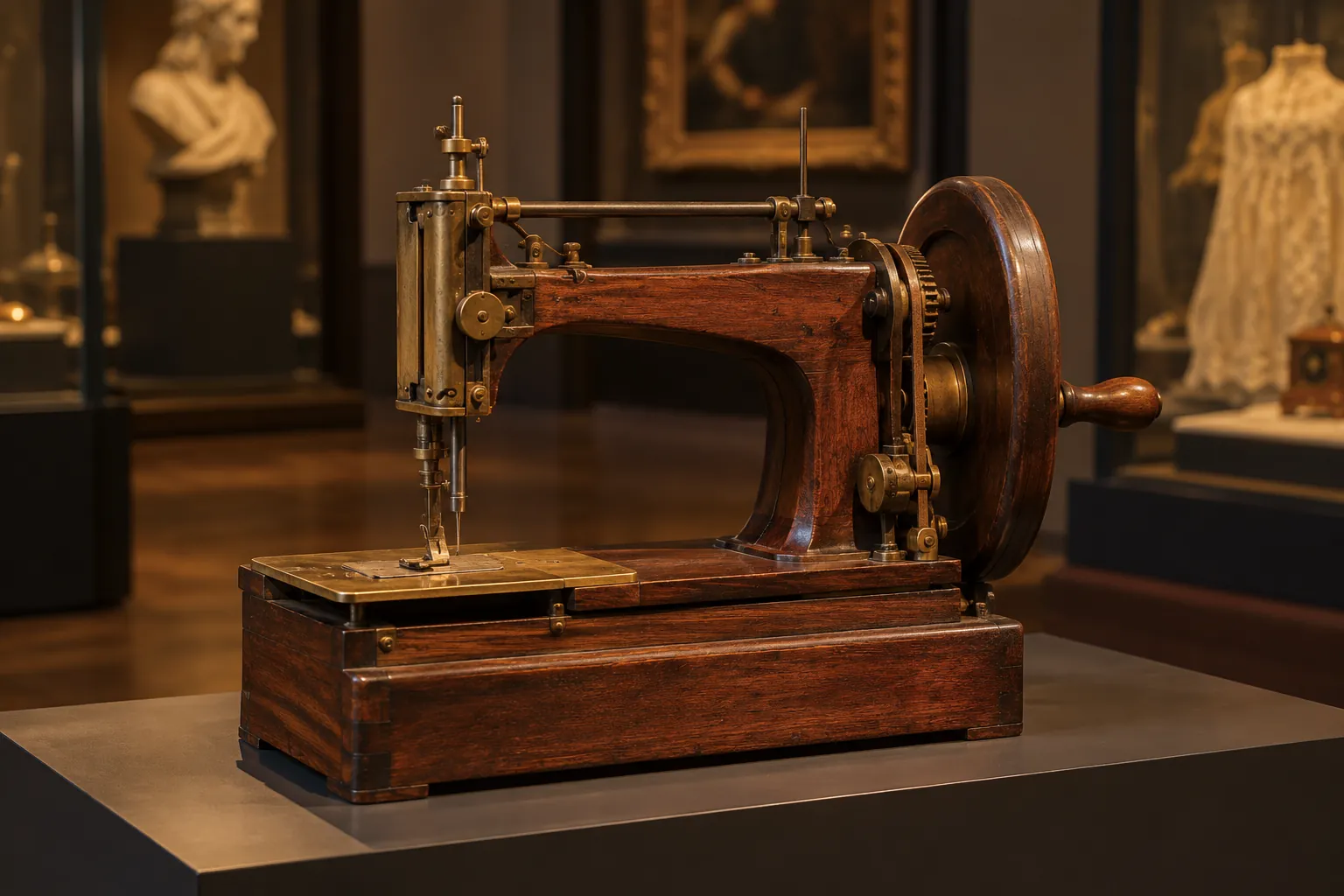
Key points
- 1790: Thomas Saint, an English inventor, drew the first known sewing machine design, for leather and canvas.
- 1830: Barthélemy Thimonnier patented a chain-stitch machine in France and set up a workshop of about 80 machines.
- 1846: Elias Howe received the first US patent for a lockstitch machine (No. 4,750).
- 1851: Isaac Singer patented a machine with a straight, up-and-down needle, a presser foot and a treadle (No. 8,294).
- 1856: the makers pooled their patents in the “Sewing Machine Combination”, which lasted until 1877.
The short answerWhen was the sewing machine invented?
The sewing machine was invented in stages between 1790 and 1851. Each inventor solved part of the problem: Saint the idea of a machine, Thimonnier a working chain-stitch machine, Hunt and Howe the two-thread lockstitch, and Singer a reliable design that families could buy.
| Year | Inventor | What they did |
|---|---|---|
| 1790 | Thomas Saint (England) | First known design: an awl pierced leather and a chain stitch closed it. No working model survives. |
| 1814–15 | Josef Madersperger (Austria) | Showed a machine in 1814 and received a privilege in 1815; it was never put into production. |
| 1830 | Barthélemy Thimonnier (France) | Patent issued 17 July 1830 for a chain-stitch machine; his Paris workshop had about 80 machines making army uniforms. |
| 1832–37 | Walter Hunt (USA) | Built the first American lockstitch machine but did not patent it. |
| 1846 | Elias Howe (USA) | First US patent for a lockstitch machine, 10 September 1846 (No. 4,750). |
| 1851 | Isaac Singer (USA) | Patent No. 8,294, 12 August 1851: vertical needle, presser foot, treadle. |
| 1851 | Allen B. Wilson (USA) | Patented the rotary hook, later used by Wheeler & Wilson. |
1790Thomas Saint: the first design
In 1790 the English inventor Thomas Saint drew a machine meant for leather and canvas, such as shoe soles. An awl made the hole and a chain stitch closed it. Wikipedia notes he probably had a working model, but none survives. In 1874 William Newton Wilson found Saint’s drawings at the UK Patent Office and built a working machine from them, which is now in the Science Museum in London.
1830Thimonnier: the first working factory
Barthélemy Thimonnier’s French patent was issued on 17 July 1830. His chain-stitch machines went into a Paris workshop making army uniforms, with around 80 machines. In 1831 a mob of tailors, afraid for their jobs, broke in and destroyed dozens of them. Thimonnier kept improving his design but died poor in 1857.
1846Hunt and Howe: the lockstitch
The lockstitch, where an upper thread and a lower thread lock together inside the fabric, is the stitch almost every household machine still makes. Walter Hunt built an American lockstitch machine in the 1830s but chose not to patent it, worried it would put seamstresses out of work.
Elias Howe was granted the first US patent for a lockstitch machine on 10 September 1846. He then spent 1849 to 1854 in court defending it. He won, and from then on other makers, Singer included, paid him royalties.
1851What did Isaac Singer invent?
Isaac Singer did not invent the sewing machine, but he made the first one that worked well enough for ordinary use. In 1850 he examined a Lerow & Blodgett machine in Boston and redesigned it. His US patent, No. 8,294, was issued on 12 August 1851.
The Smithsonian, which holds his patent model, credits him with replacing the earlier curved, horizontal needle with a straight needle moving up and down, and with a treadle that let the sewer power the machine with her feet. The design also had a presser foot to hold the cloth and an overhanging arm, so it could sew continuous and curved seams.
Singer’s bigger contribution may have been selling. His partner Edward Clark introduced instalment buying in 1856, so families could pay over time. Read more in our Singer company history.
1856The “Sewing Machine War” and the patent pool
By the early 1850s the main makers were suing each other over who owned which idea. On 24 October 1856 Howe, Wheeler & Wilson, I. M. Singer & Co. and Grover & Baker signed the Albany Agreement, pooling their patents in the Sewing Machine Combination. Wikipedia says Howe received a $5 royalty for each machine sold in the US under the pool; the last pooled patent expired in 1877.
Your machineHow old is your machine?
Most machines found in homes today date from long after these pioneers: Singer made millions between the 1870s and the 1970s. To find out when yours was made, look up the serial number, then see where it fits in Singer’s models decade by decade.
QuestionsFrequently asked questions
Who invented the first sewing machine?
Thomas Saint drew the first known design in England in 1790. Barthélemy Thimonnier patented the first machine put to practical use, in France in 1830.
Did Isaac Singer invent the sewing machine?
No. Singer patented an improved, practical machine in 1851, with a straight up-and-down needle, a presser foot and a treadle, and built the company that sold it worldwide.
Who invented the lockstitch sewing machine?
Walter Hunt built one in the 1830s but did not patent it. Elias Howe received the first US lockstitch patent on 10 September 1846.
Why was the sewing machine invented?
To speed up sewing, which was done entirely by hand. Thimonnier’s first workshop made army uniforms; Singer’s machine was aimed at clothing makers and then at families.
Where was the sewing machine invented?
The idea developed in England (Saint), Austria (Madersperger), France (Thimonnier) and the United States (Hunt, Howe, Singer and Wilson).
ReferencesSources
These are the pages and manuals the facts in this article come from. Where they disagree, we say so in the text.
- en.wikipedia.org/wiki/Sewing_machine
- en.wikipedia.org/wiki/Thomas_Saint
- en.wikipedia.org/wiki/Josef_Madersperger
- en.wikipedia.org/wiki/Barth%C3%A9lemy_Thimonnier
- en.wikipedia.org/wiki/Walter_Hunt_(inventor)
- en.wikipedia.org/wiki/Elias_Howe
- si.edu/object/nmah_1071133
- lemelson.mit.edu/resources/isaac-singer
- en.wikipedia.org/wiki/Allen_B._Wilson
- en.wikipedia.org/wiki/Sewing_Machine_Combination
Published 24 October 2026 · Written and fact-checked by the HeirloomID editors. Spotted an error? Tell us.